The Changing Equation of Love in Music
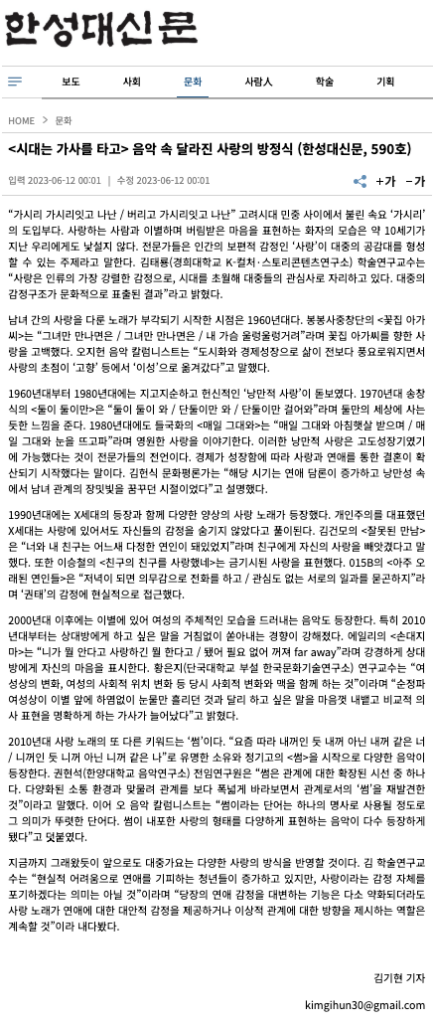
This article traces how representations of love in Korean popular music have changed alongside Korean society. Although love has remained a universal theme across generations, its musical expression has continually evolved in response to economic growth, shifting gender roles, individualism, and changing forms of relationships.
Romantic love between men and women became increasingly prominent in Korean popular music during the 1960s. Music columnist Jiheon Oh explained that as urbanization and economic growth made everyday life more prosperous, the focus of love songs gradually shifted from subjects such as one’s hometown to romantic partners. From the 1960s through the 1980s, popular songs frequently portrayed devoted, idealized, and enduring love.
With the emergence of Generation X in the 1990s, love songs began to address more diverse and realistic emotions, including betrayal, forbidden relationships, and emotional fatigue between long-term partners. From the 2000s onward, songs increasingly presented women as active and outspoken subjects who expressed anger, independence, and their own decisions following a breakup.
The 2010s introduced another important theme: sseom, a Korean term describing an ambiguous relationship that exists somewhere between friendship and romance. Oh noted that the term had developed a distinct meaning of its own, leading to the emergence of numerous songs exploring the varied emotions and relationships contained within it.
The article concludes that popular music will continue to reflect changing forms of love. Even as social and economic pressures make relationships more difficult, love songs remain a means of imagining alternative emotions and new possibilities for connection.
Expert Commentary — Jiheon Oh
Hansung University Press, Issue 586